Aristoteles Osegueda 4
Aristoteles Osegueda 4
10 Glossary Week 4 terms
- Convection heat transfer coefficient
- noun
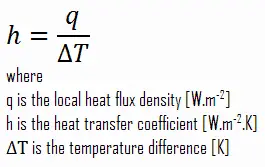
- The convective heat transfer coefficient, h, can be defined as:
The rate of heat transfer between a solid surface and a fluid per unit area per unit temperature difference.
- en: Coeficiente de transferencia de calor por convección
- Critical Reynold’s number
- noun
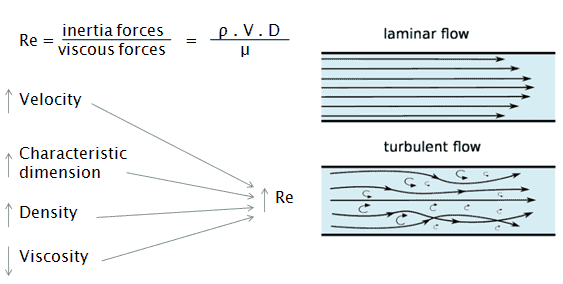
- The Reynolds number is the ratio of inertial forces to viscous forces and is a convenient parameter to predict whether a flow condition will be laminar or turbulent. The critical Reynolds number is associated with the laminar-turbulent transition, in which a laminar flow becomes turbulent.
- en: Número crítico de Reynolds

- Friction Coefficient
- noun
- The coefficient of friction is the ratio of the sliding force to the holding force exerted by two surfaces in contact. This coefficient is in fact an evaluation of the difficulty with which the surface of one material will slide over another material.
- en: Coeficiente de fricción

- Kinematic viscosity
- noun
- Kinematic viscosity is a measure of the internal resistance of a fluid to flow under gravitational forces. It is determined by measuring the time in seconds required for a fixed volume of fluid to flow by gravity a known distance through a capillary into a calibrated viscometer at a closely controlled temperature.
- en: Viscosidad cinemática

- Laminar flow
- conjunction
- Laminar flow or laminar current is called the movement of a fluid when it is ordered, stratified or smooth. In laminar flow, the fluid moves in parallel sheets without intermingling and each fluid particle follows a smooth path, called a streamline.
- en: Flujo laminar

- Nusselt number
- noun
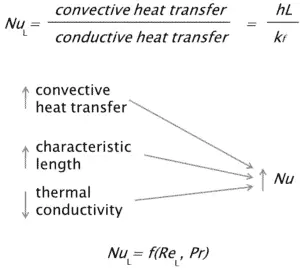
- The Nusselt number is a dimensionless number, named for a German engineer Wilhelm Nusselt. The Nusselt number is closely related to the Péclet number and both numbers are used to describe the ratio of the thermal energy that is convinced to the fluid with respect to the thermal energy conducted within the fluid.
- en: Número de Nusselt
- Prandtl number
- noun
- The Prandtl number is a dimensionless number, named for its inventor, the German engineer Ludwig Prandtl, who also identified the boundary layer. The Prandtl number is defined as the ratio of impulse diffusivity to thermal diffusivity. Moment diffusivity, or as it is commonly called, kinematic viscosity, tells us the resistance of the material to shear flows (different layers of the flow travel with different speeds due, for example, to different speeds of adjacent walls) in relation to the density.
- en: Número de prandtl

- Reynold number
- conjunction
- The Reynolds number is the ratio of inertial forces to viscous forces and is a convenient parameter to predict whether a flow condition will be laminar or turbulent.
- en: Número de Reynold
- Shear stress
- noun
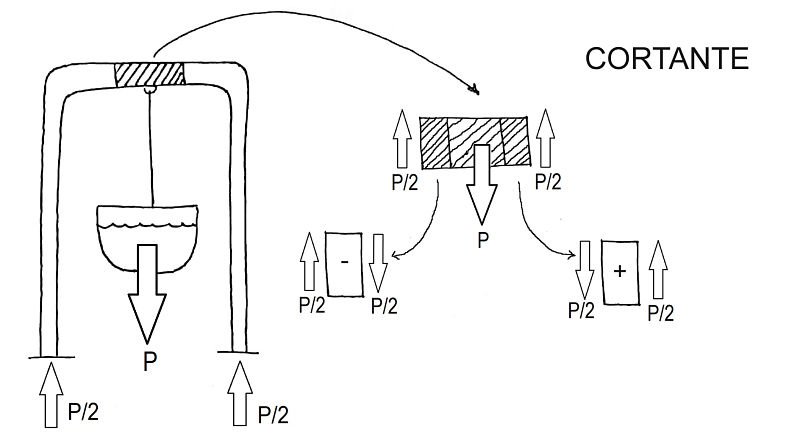
- As a definition, we can say that the force that is parallel to a straight section of the bar is called shear stress in a bar.
Continuing with the solicitations or efforts in the bar structures, we will now deal with the shear.
- en: Esfuerzo cortante
- Turbulent flow
- conjunction
- In fluid dynamics, turbulent flow is characterized by the irregular movement of particles (we can say chaotic) of the fluid. Unlike laminar flow, the fluid does not flow in parallel layers, the lateral mixing is very high, and there is a gap between the layers.
- en: Flujo turbulento